
Bleak House 1853
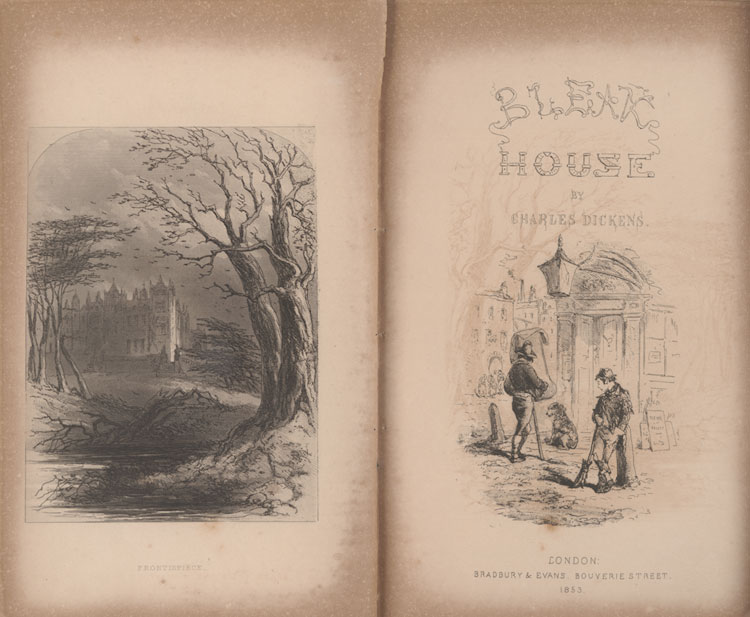 Engraved frontispiece and title pageCharles Dickens. Bleak House. With illustrations by H.K. Browne. London: Bradbury and Evans, 1853 [Rare Books Collection PR4556.A1 1853]
Bleak House is considered by many to be Dickens's masterpiece. It is brilliantly written, tightly plotted, and has many memorable characters. The novel embodies an underlying critique of the British legal system, and indeed is said to have hastened the abolition of the Court of Chancery, heavily criticised in the story.
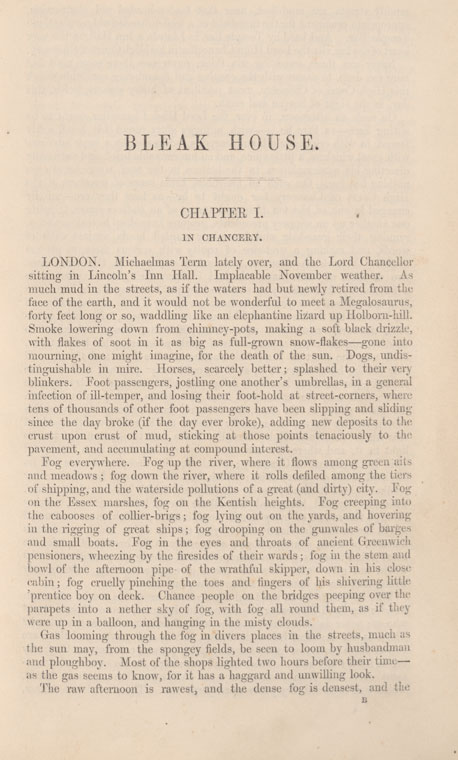 First page of textThe novel's opening page is especially memorable, with its image of London imbued with mud, and swathed in fog, and of a great megalosaurus waddling its bulk up Holborn Hill. The analogy reflects upon the antediluvian legal culture Dickens himself had witnessed as a law clerk and journalist, and shows his mature style as the storyteller and exposer/analyst of wrongs. Holborn Hill of course linked the Old Bailey and the Inns of court at Gray's Inn and Chancery Lane.
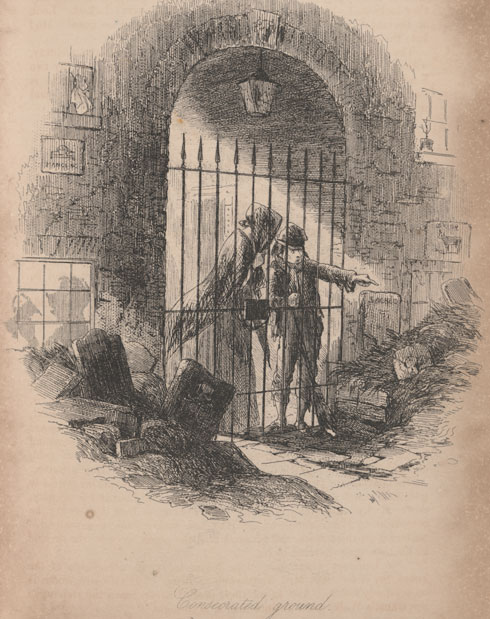 Consecrated groundAt the centre of the book is a legal case which is made to continue so long that all the fortune which it originally concerned has disappeared in legal fees by the time it ends – having enriched lawyers along the way, and having blighted the many lives that its funds might have benefitted. Dickens had witnessed the institutional peculation of the law at first hand, and had personally observed the profound disjunction between law and justice.
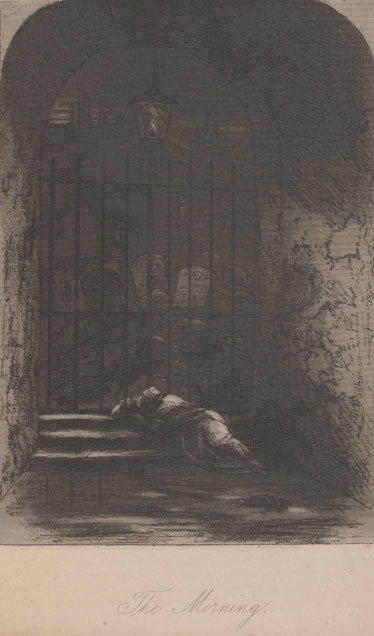 The morningOther themes raised in the book are the desperate state of urban burial grounds, and the interdependence of poverty and wealth. He wove a tragic love story through the book, in which real love is blighted by archaic social conventions, and loveless marriages in high society are held in place by rigid formality.
In this exhibition
- Dickens: life from birth to 'Boz'
- Dickens: at 'The Mirror of Parliament'
- Dickens: early pseudonymous works reviewed
- A chronology of Dickens's major works
- Seven Dickens first editions
- A Dickens manuscript letter, 1847
- An original Dickens speech
- Further reading