
Our Mutual Friend 1865
 Engraved title pageCharles Dickens. Our Mutual Friend. With illustrations by Marcus Stone. London: Chapman and Hall, 1865 [Rarebooks Collection PR4568.A1 1865]
Our Mutual Friend was the last great novel Dickens completed before his death in 1870. It centres upon the uses and moral meaning of money, in society and in private life.
The book's early chapters are particularly memorable, especially the dark gothic atmosphere of the novel's opening pages in which Gaffer and Lizzie Hexam navigate the tidal Thames, seeking drowned corpses to land. The contrast with the superficial Veneerings in chapter two, who have everything new – including their house and china, servants and friends – is very stark.
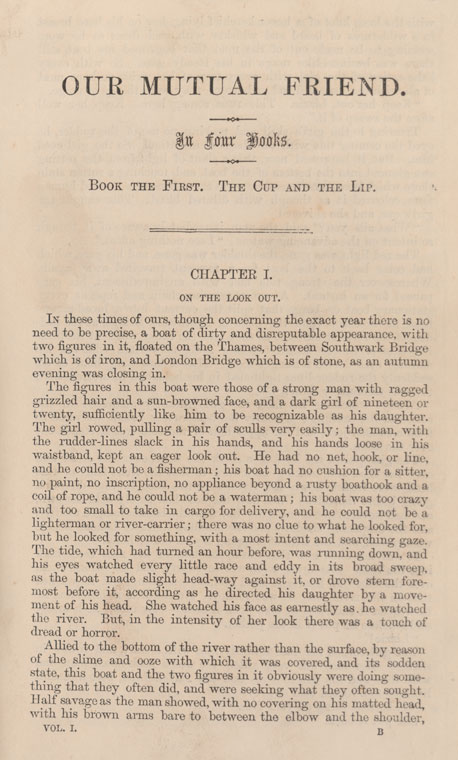 First page of textThe book's core location is a London dust heap, whose owner, the 'Golden Dustman' is one of the main protagonists. Another key site of action is the shop belonging to Mr Venus, a dealer in preserved body partsand taxidermy, Dickens's description of which is extraordinary.
 Mr Venus surrounded by the trophies of his artThe novel revolves around a fortune of money left to a young man on condition that he marries the woman of his father's choice. A body fished out of the Thames is identified as his, and the fortune goes instead to an old employee of his father's, Mr Boffin, who becomes the 'Golden Dustman'.
At first charitable and beneficent, he later becomes more Scrooge-like as he tries to improve the selfish character of Miss Wilfer, the young woman who had been intended for his employer's daughter in law. It later turns out that his secretary, John Rokesmith, is the missing young man and he and an improved Miss Wilfer actually fall in love, while Mr Boffin's meanness turns out to be an act, and he happily resigns his role in favour of the fortunate young couple.
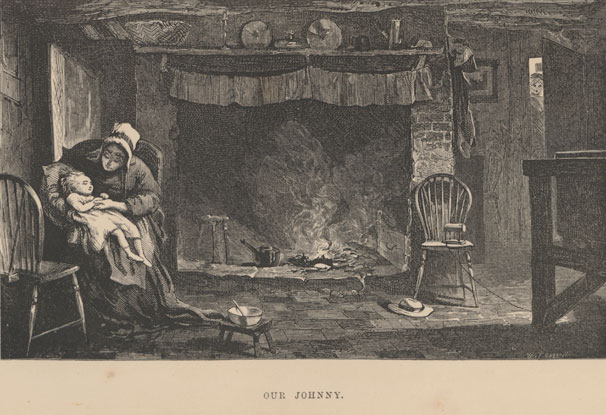 Our JohnnyThe image shown here of 'Our Johnny' was by Marcus Stone, engraved on wood by the Dalziels, and worthy of a Dutch master in its atmospheric quality: it could easily have been one of those many Englishwood engravings so admired by Van Gogh, especially when one looks carefully at the chairs. The woman seated with the sick child is Betty Higden, who later avoids death in the workhouse by a deliberate policy of sleeping out under the stars.
In this exhibition
- Dickens: life from birth to 'Boz'
- Dickens: at 'The Mirror of Parliament'
- Dickens: early pseudonymous works reviewed
- A chronology of Dickens's major works
- Seven Dickens first editions
- A Dickens manuscript letter, 1847
- An original Dickens speech
- Further reading